Welcome to the Metasocial Life: How Social Is Social?
We live in an era where the word „social” has been entirely hollowed out and repurposed. The moment we step outside, live our lives, or go out and about, our immediate evolutionary impulse is no longer just to experience the moment—it is to collect material to brag about on social media platforms.
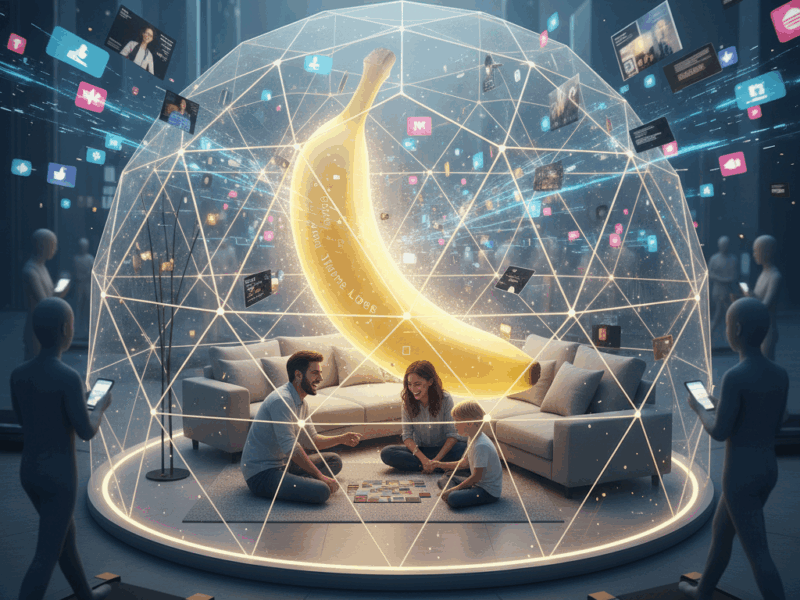
But how social is „social media,” really? Given that we don’t see each other face-to-face and capture only fractured, curated parts of a sprawling reality, we have traded genuine human proximity for a performative echo chamber.
The truth is, there isn’t actually much to brag about in our ordinary daily lives. Yet, the static images we post sell a flawless, perfect picture. Today, we are societally challenged to embrace this sort of online bragging; we are trapped in a system where if you do not broadcast your existence online, you cease to exist to the collective consciousness.
1. The Death of the Physical Agora
To understand how claustrophobic our modern social structure has become, we only need to look at history.
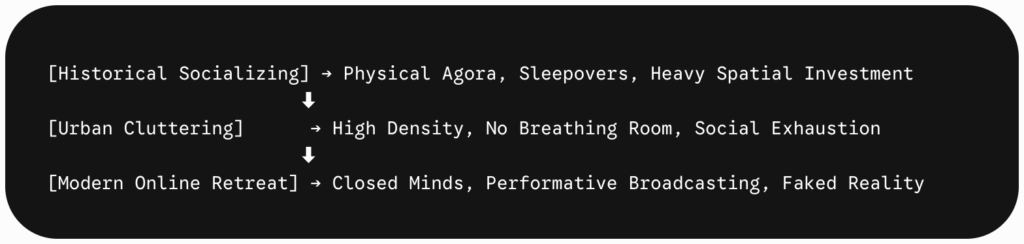
Imagine the world of Downton Abbey in the countryside, where socialization was an intensive, tactile architectural project. To connect, families had to organize massive events, invite peers across counties, and host people for long sleepovers. Imagine The Gilded Age, where to be socially admitted into the elite fabric, you had to physically occupy downtown spaces and possess the financial and emotional capacity to afford having people over.
The historical examples show that our modern society, by cluttering us into dense urban spaces, has paradoxically left us with very little physical breathing room or genuine speaking chances. To avoid the overwhelming chaos of the physical crowds, we have retreated. We have closed our minds within our online presence. There, behind the safety of a glass screen, we show off with highly polished pictures just to remain socially acceptable.
When you wake up every morning, open an app, and immediately begin building on FOMO (Fear of Missing Out), you are funding an illusion. It is not the type of real life you actually want.
2. What We are Missing: The Micro-Interactions of Real Life
By shifting our existence into the digital sphere, we have edited out the small, human signatures of daily life.
We are missing out on the spontaneous morning coffee interaction. The simple, tactile decisions of the day: Where would you buy and drink your coffee? Why not invite someone over spontaneously?
We no longer check in with our internal state before engaging. We don’t ask ourselves: Are you in the mood? If yes, meet outside. If you are not in the mood, then great—skip it. Online, you cannot skip; the platform demands continuous presence, forcing you to simulate being „in the mood” 24/7.
Instead of shared experiences, we find ourselves having lonely lunches at the office desk, staring at screens while swallowing food. This mechanical routine quietly breaks our general mindset.
Imagine if you actually had the time to sit with yourself—not even to perform a trendy meditation, but simply to run over what happened yesterday, to review the data of your own life. If you possess that luxury, you are actually richer than most people on Earth. The majority of society no longer has this uninterrupted moment to relive, audit, and judge their own history.
3. Metacognition: The Psychology of the Pattern Break
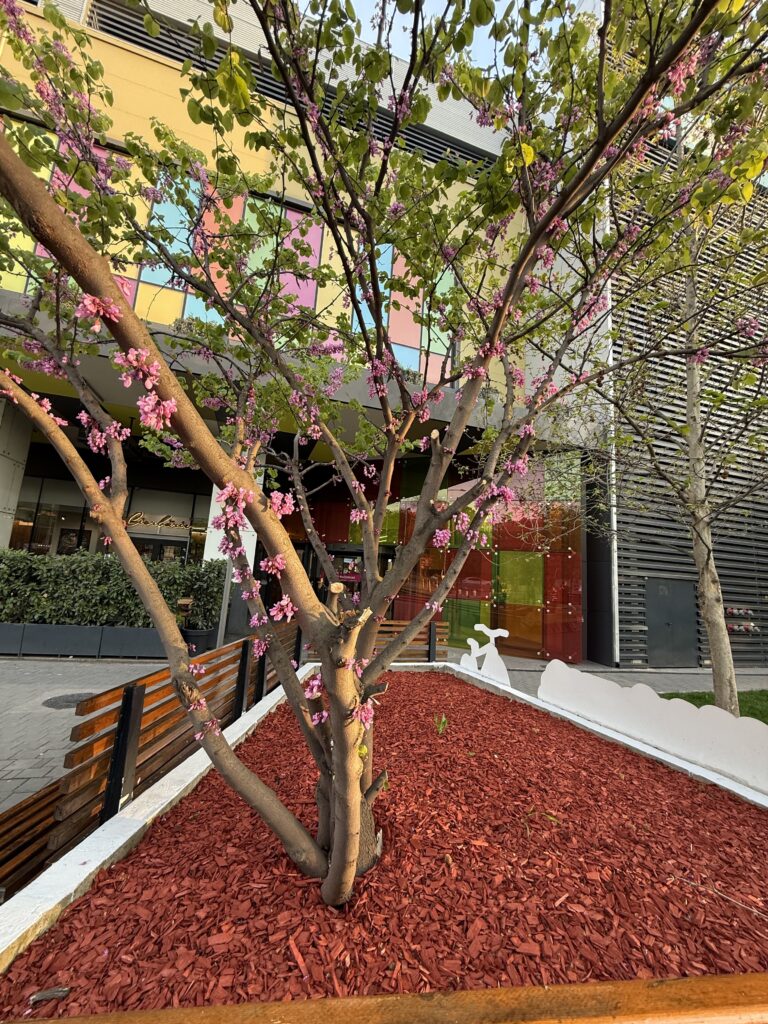
Reviewing one’s internal state—metacognition—is often talked about as a vital skill of the past. It is an internal exercise I have done automatically since I was a child. People around me would often smile, watching me process my thoughts, thinking I was acting as my own psychologist.
In reality, I am just performing a diagnostic checkup on my own mind. I am trying to locate the source code: What triggered my reaction? What actually happened in that friction point? What is it that I can do differently in the future?
It is incredibly hard to speak up in today’s world and admit that some of us occupy a completely different position—that we prefer internal calibration over external validation.
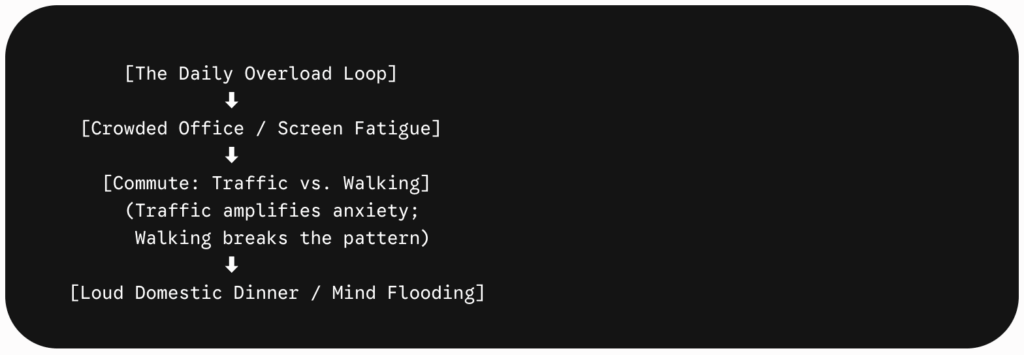
This internal calibration becomes critical at the end of the day. If we do manage to get home at a decent time, we often walk right into a very loud dinner where everyone in the family wants to share their thoughts simultaneously. Meanwhile, our brains are still heavily overloaded from the day’s administrative burden.
How do we calm the system down? Do we do it in traffic, or by walking?
I choose walking. Walking breaks all passive patterns, replacing them with sudden, tactile real-world stimuli—especially if you make the conscious choice to go down completely different streets every single time.
Traffic, on the other hand, merely amplifies the chaotic thoughts of the day. It traps you in an enclosed box, forcing you to obsess over the calls you never got around to making.
4. Embracing the „Missing Out”
Sometimes, not having that automatic, instant „Hello!” actually helps our psychology. It builds on the forgotten art of missing out.
As a society, we got addicted to the convenience of the daily call. We never get the chance to truly miss the people we barely see face-to-face, because we hear from them through a digital wire every single day. By removing distance, we stopped having the profound feeling of longing. And this hyper-connectivity is, once again, breaking our human framework.
Imagine the freedom of actively needing to miss out on things. Yes, I will probably never own a Ferrari. But if I run a straight-minded audit on my desires, the truth is I don’t even want a Ferrari.
I would rather have the quiet peace of mind to create more, to think deeply, and to drop more raw ideas out into the big world.
Welcome to the Metasocial Age
I do not pretend to hold the master solution to reintegrate humans into their real, physical worlds. But every single day, I try to break the digital patterns that threaten to break me from being human.
And so, in this era of massive AI adoption and a terrifyingly fast-paced world, I made a deliberate choice. I chose to let an artificial intelligence read my raw, chaotic, unfiltered lines of thought and summarize them into this structured piece for an easy public read.
I did this to save time, yes, but also to build my own human ideas directly into the massive, growing world of machines. If these algorithms are destined to live among us and possess the terrifying ability to learn, why not actively teach them what it feels like to be human?
I believe that if I am capable of helping, communicating with, and integrating complex people in the real world, I can do the exact same with machines.
Welcome to a very metasocial life—a life where humans must consciously act upon, instruct, and master the very social systems they created.